Cholesterol
The problem is not cholesterol itself. It is excess atherogenic cholesterol over time.
Cholesterol is a natural substance that is essential to our bodies. But when cholesterol carried by atherogenic lipoproteins, especially LDL, remains too high for years, it can accumulate in artery walls and promote atherosclerosis.
Knowing your LDL cholesterol means understanding an important part of your risk.
What is cholesterol?
Cholesterol is not a “bad” substance: it is an essential component of cell membranes and is needed for many biological functions. Some comes from food, while a substantial proportion is produced by the body, primarily in the liver.
In the blood, cholesterol travels inside particles called lipoproteins. This is why total cholesterol alone does not fully describe risk.
LDL
So-called bad cholesterol
LDL particles carry cholesterol from the liver to the tissues. In excess, they promote cholesterol buildup in artery walls, contributing to atherosclerotic plaques that can cause heart attacks and strokes.
HDL
So-called good cholesterol
HDL particles help collect excess cholesterol from tissues and carry it to the liver, where it can be reused or eliminated. They therefore play an important role in cholesterol metabolism.
Triglycerides
Another important component of the lipid profile, they can contribute to risk, particularly in certain metabolic contexts.
Non-HDL cholesterol / ApoB
These can help provide a better estimate of the overall burden of atherogenic lipoproteins in selected patients.
What happens when LDL cholesterol is high?
Lipoproteins containing apolipoprotein B, particularly LDL, have a causal role in the development of atherosclerosis. When present in excess in the circulation, they can enter artery walls and contribute over time to the formation of atherosclerotic plaques.

The longer arteries are exposed to high LDL levels, the greater the atherosclerotic burden can become.
What can this cause over time?
Atherosclerosis can develop slowly and remain silent for many years. When a plaque grows, narrows an artery or becomes unstable, cardiovascular disease can become apparent.
Heart
Coronary artery disease, angina and myocardial infarction.
Brain
Ischemic stroke and other cerebrovascular manifestations.
Peripheral arteries
Lower-extremity peripheral artery disease and atherosclerosis in other locations.
Aorta / other vascular areas
Atherosclerosis can affect several vascular territories at the same time.
Is there a right cholesterol level for everyone?
No. The significance of an LDL level depends on the person's overall cardiovascular risk. Age, blood pressure, smoking, diabetes, kidney function, family history, existing atherosclerosis and previous cardiovascular events affect the level of risk and therefore how intensively LDL should be lowered.
See the figure from the European Society of Cardiology guidelines.
European Heart Journal (2025) 00, 1–20

Score < 1%
Score ≥ 1% and < 5%
Young patients (T1DM <35 years; T2DM <50% as written in the source figure), with diabetes duration <10 years and no other risk factors.
Score ≥ 5% and < 10%
Markedly elevated individual risk factors, particularly total cholesterol >8 mmol/L (310 mg/dL), LDL-C >4.9 mmol/L (190 mg/dL), or blood pressure ≥180/110 mmHg
Familial hypercholesterolemia without other major risk factors
Moderate CKD (eGFR 30–59 mL/min)
Diabetes for ≥10 years with organ damage or additional risk factors
ASCVD (clinical/imaging)
Score ≥ 10%
Familial hypercholesterolemia with ASCVD or other major risk factors
Severe CKD (eGFR <30 mL/min)
Diabetes with organ damage, ≥3 major risk factors, or early-onset T1DM of long duration (>20 years)
There is no single number that applies to everyone.
The target level must be interpreted in the context of individual cardiovascular risk.
How is a lipid profile measured?
A simple blood test measures the lipid profile: total cholesterol, LDL-C, HDL-C and triglycerides. The blood sample for a lipid profile should be taken while fasting, avoiding high-fat meals and substantial amounts of alcohol in the days before the test.
A test worth considering: lipoprotein(a)
Lipoprotein(a), or Lp(a), is a lipoprotein largely determined by genetics.
-
It is an independent risk factor.
-
It promotes plaque buildup in the arteries and blood clotting regardless of traditional cholesterol levels.
-
More than 90% of its level is determined by DNA, and it does not change with diet or physical activity.
-
Because levels remain stable during adulthood, guidelines recommend measuring it with a blood test at least once in a lifetime.
-
Elevated levels above 50 mg/dL indicate high cardiovascular risk and can help identify people for whom lowering LDL cholesterol is essential.
-
Approximately 20% of the world's population has high levels.
Can cholesterol-related cardiovascular risk be reduced?
Yes. The approach depends on the LDL level and, above all, overall cardiovascular risk.
Balanced diet
Appropriate weight
Regular physical activity
No smoking
Blood pressure and blood glucose management
Lipid-lowering treatment when indicated
Lifestyle is fundamental to cardiovascular prevention. However, when cardiovascular risk is high and LDL levels need to be lowered, effective medications are available. Statins (see figure) remain the first-line treatment. For patients who do not reach their target or cannot tolerate statins, other therapies with documented cardiovascular benefits may be used when clinically indicated.
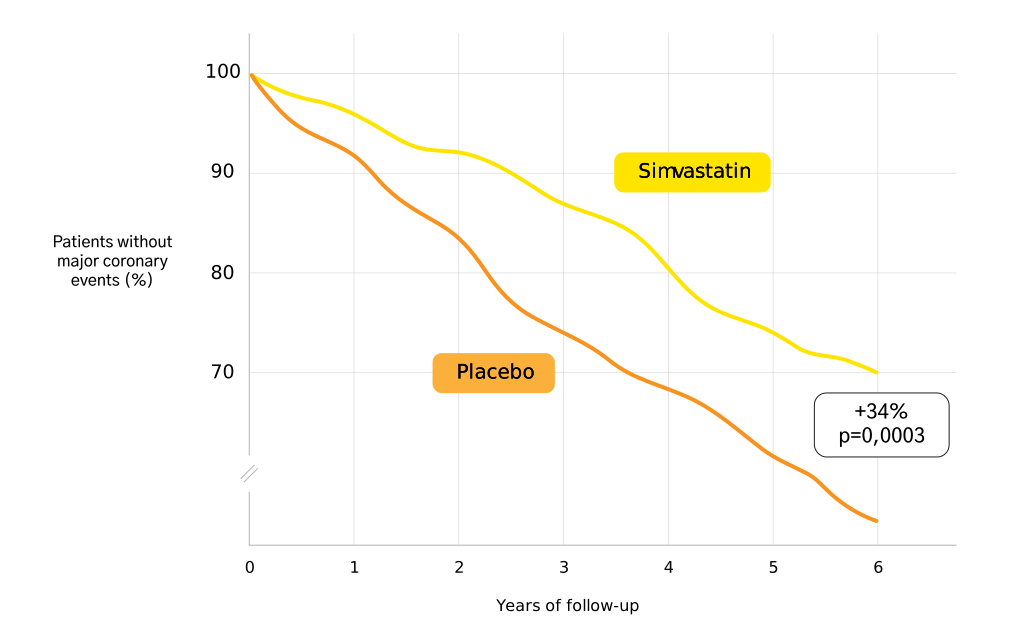
The Scandinavian Simvastatin Survival Study (4S), published in 1994, was the first large clinical trial — involving 4,444 patients at 94 centers — to show that a statin, simvastatin, significantly reduces mortality in patients with heart disease.
Treatment should be personalized. The goal is not simply to “lower cholesterol,” but to reduce the likelihood of a cardiovascular event.
Lowering LDL means reducing atherosclerotic risk
Knowing your lipid profile, assessing it alongside other risk factors and taking action when needed means protecting your arteries before disease develops.
Know
Assess your risk
Act
Scientific sources
European Society of Cardiology / European Atherosclerosis Society. 2025 Focused Update of the 2019 ESC/EAS Guidelines for the management of dyslipidaemias.
European Atherosclerosis Society / European Federation of Clinical Chemistry and Laboratory Medicine. Consensus on fasting and non-fasting lipid profiles.
ACC/AHA et al. 2026 Guideline on the Management of Dyslipidemia. Scandinavian Simvastatin Survival Study Group (November 19, 1994). “Randomised trial of cholesterol lowering in 4444 patients with coronary heart disease: the Scandinavian Simvastatin Survival Study (4S)”. The Lancet. 344 (8934): 1383–1389.